
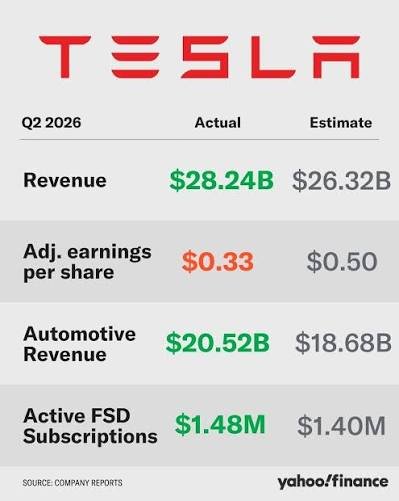
Key Highlights of Tesla's Q2 Performance
Tesla recently released its second-quarter financial results, revealing a clear split between strong top-line sales growth and tightening profit margins. The electric vehicle maker generated total revenue of $28.24 billion, which easily surpassed analyst predictions. However, higher operational spending and price cuts reduced overall profits. You can check official investor documents on the
Total Revenue: Reached $28.24 billion, representing a 26% year-over-year increase.
Vehicle Deliveries: Hit a strong 480,126 units globally during the quarter.
Operating Margin: Dropped to 1.4% due to price discounts and heavier operational spending.
Free Cash Flow: Showed a negative $1.1 billion cash burn following major artificial intelligence investments.
Revenue Growth Driven by Higher Deliveries
Tesla saw a strong rebound in vehicle shipments during the quarter. Lower car prices and promotional financing packages helped attract budget-conscious buyers across key international markets. Automotive revenues grew 23% year-over-year to $20.52 billion, while services and energy divisions also showed healthy growth figures. According to coverage from
Profit Margins and Higher Operating Costs
Despite top-line gains, profits took a noticeable hit. Adjusted net income fell below Wall Street expectations as price reductions squeezed profit per vehicle. Furthermore, regulatory credit sales—which historically provided high-margin income—dropped sharply to $146 million. Detailed analysis in the
Big Shift Toward Artificial Intelligence and Robotics
Company leadership continues to direct massive capital toward autonomous technology. Capital expenditure spiked as Tesla invested heavily in computing chips, power grids, and research infrastructure. The company is actively building out its Robotaxi service networks alongside humanoid robot development. As noted in